Jimi Hendrix and You;ll Never Hear Surf Music Again
| "Third Stone from the Dominicus" | |
|---|---|
| Song by the Jimi Hendrix Experience | |
| from the album Are You lot Experienced | |
| Released |
|
| Recorded | London, January & Apr 1967 |
| Genre |
|
| Length | half dozen:xxx [1] |
| Label |
|
| Songwriter(southward) | Jimi Hendrix |
| Producer(south) | Chas Chandler |
"Third Stone from the Lord's day" (or "3rd Stone from the Sun") is a mostly instrumental composition past American musician Jimi Hendrix. It incorporates several musical approaches, including jazz and psychedelic rock, with brief spoken passages. The title reflects Hendrix'south involvement in science fiction and is a reference to Earth in its position as the third planet away from the sun in the solar system.
Hendrix developed elements of the slice prior to forming his group, the Jimi Hendrix Experience. The Experience recorded versions every bit early as December 1966, and, in 1967, it was included on their debut anthology Are You Experienced. Several artists have recorded renditions and others have adapted the guitar melody line for other songs.
Groundwork [edit]
In the summertime of 1966, Hendrix relocated to New York City's Greenwich Village. At that place he explored a stone sound outside of the musical confines of the Harlem rhythm and blues scene. While performing with his group Jimmy James and the Blue Flames at the Buffet Wha?, Hendrix played elements or early versions of "Third Stone from the Sun".[two] [three] [4] He connected to develop it after moving to England with new manager Chas Chandler. The two shared an interest in scientific discipline fiction writing,[v] including that of American author Philip Jose Farmer.[a] Chandler recalled:
I had dozens of science fiction books at home ... The first one Jimi read was World Abides. It wasn't a Wink Gordon type, it'south an stop-of-the-world, new first, disaster-blazon story. He started reading through them all. That where 'Tertiary Stone from the Sun' and 'Up from the Skies' came from.[7]
Music journalist Charles Shaar Murray associates information technology with the "hazy cosmic jive directly out of the Sun Ra scientific discipline fiction textbook."[8] Hendrix chronicler Harry Shapiro suggests that his reference of a hen may have been inspired by "Ain't Nobody Hither but Us Chickens", a jump blues song by Louis Jordan.[9] Jordan's song was one of the biggest hits of 1946 and was pop with rhythm and blues bands in Seattle, where Hendrix grew up and first performed.[9]
Composition [edit]
Hendrix biographer Keith Shadwick describes "Third Stone from the Sun" as "a structured group performance" equanimous of several identifiable passages or sections with further subdivisions.[10]The first section opens with guitar chording, which Murray notes as "sliding major ninth ... arpeggiated chords and Coltranoid mock-orientalisms" with Mitch Mitchell's Elvin Jones-influenced drumming.[8] After several bars of the intro, Hendrix moves to a Wes Montgomery-way octave guitar melody line.[ten] Information technology is one of Hendrix's about recognizable guitar figures and is notated in common or 4/4 time time in the cardinal of E:

Several writers have noted the jazz influences in the beginning department.[11] [12] [10] Nevertheless, Shadwick points out that "at no indicate does the band audio merely like a group of musicians imitating other styles. They have their own musical identity."[10] Midway, Hendrix adds a bluesy guitar improvisation part with Mitchell and Redding switching to a more standard rock rhythm backing, before returning to the guitar tune.[8] [10]
Effectually two:30, Hendrix abruptly changes direction with a vibrato arm dive, which sets the stage for the 2d department and his feedback-laden guitar improvisations.[8] Music critic Richie Unterberger described it as an "instrumental freak-out jam"[13] and "a tour de forcefulness of psychedelic guitar".[11] Redding anchors the section with a 3-annotation bass ostinato while Mitchell provides rhythmic improvisation.[x] Shadwick describes Hendrix's solo:
[T]his is non an orthodox guitar solo. It is more akin to a soundscape forged from his control of amplified feedback and the manner he manipulates the Stratocaster's [guitar's] concrete characteristics, including its switches and vibrato arm.[10]
Murray notes that he performs largely independent of rhythm, tonality, or notes and enters into pure sound, which he describes as:[8]
[S]creams, whinnies, sirens, revving motorbike engines, burglar alarms, explosions, dawdling fizz-saws, subway trains, the rattling of disintegrating industrial mechanism, the howl and the whine of motor shells.[8]
To air current downwardly, Hendrix returns to the guitar melody line, although with more distortion and vibrato.[ten] The instrumental concludes with "what was possibly the Feel's version of Armageddon" and a fade.[10]
Spoken sections [edit]
Spoken sections, oft slowed downward and otherwise sonically manipulated, run intermittently throughout the piece.[11] Hendrix and Chandler recorded the dialogue, which parodies a science fiction scenario. Shadwick notes the joking nature,[ten] although Hendrix described it thing-of-factly:
These guys come from some other planet, you know ... they detect Earth for a while and they recall the smartest animate being on the whole Earth is chickens [and] there's nothing else there, so they just blow it up at the end.[9]
The dialogue opens with a mock advice betwixt alien space explorers slowed to half-speed, which makes it mostly unintelligible.[9]
Hendrix: Star armada to lookout ship, please give your position. Over.
Chandler: I am in orbit effectually the tertiary planet of star chosen the Sun. Over.
Hendrix: You mean information technology'south the Earth? Over.
Chandler: Positive. It is known to have some form of intelligent species. Over.
Hendrix: I think we should take a look.[14]
The alien visitor, voiced by Hendrix at normal speed, makes some observations of the planet.[12] He marvels at the "regal and superior cackling hen", simply dismisses the people and concludes:[half-dozen]
So to you I shall put an end
And you'll never hear surf music once more ...
[At half-speed] That sounds like a lie to me
Come up on man, allow'due south go home[xiv]
Music journalist Peter Doggett notes the irony of the surf music reference.[15] In 1970, business manager Michael Jeffery committed Hendrix to contributing to the soundtrack for Rainbow Bridge; his music is heard during surfing scenes with David Nuuhiwa and others.[16] [b] Pioneer surf guitarist Dick Dale, who claimed to have met Hendrix in Los Angeles in 1964, believed the mention was Hendrix'due south way of encouraging his recuperation when Dale was seriously ill.[eighteen]
Recording [edit]
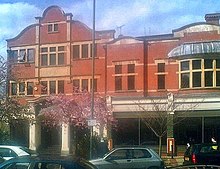
"Tertiary Stone from the Sun" was one of the earliest recordings attempted by the Experience.[19] They recorded a demo version at CBS studios in London on December 13, 1966.[20] However, because of a dispute over studio fees, it was left unfinished.[21] On January 11, 1967, several takes were recorded at De Lane Lea Studios in London, but a master was not realized.[22] Work on the rail resumed on Apr 4, 1967, at Olympic Studios in London.[23] Session engineer Eddie Kramer recalls that the original recording was largely abandoned and replaced with new overdubs.[24]
The master for the track was finally completed on April x, 1967, besides at Olympic.[23] At this session, the spoken sections and sound effects were recorded and the last audio mixing took identify.[25] Several takes were required since Hendrix and Chandler were joking and laughing throughout the session.[25] Hendrix biographer and subsequently producer John McDermott notes that it shows the esprit enjoyed by the two during the early days of the Experience.[five]
The instrumental makes novel use of recording and mixing. Hendrix contributed to the audio furnishings past moving his headphones around the microphone to alter the audio of his whispers and breathing.[25] In preparing the final mix, Kramer experimented with the rails's sound imaging or an instrument's apparent placement, but was limited by the existing technology.[25] He after explained:
That song was like a watercolor painting ... to create a sense of movement inside the overall audio, I pushed Mitch's [drummer Mitch Mitchell's] cymbals forward in the mix and panned the 4 tracks on the finished principal. Each track was composed of 4, fairly dumbo, composite images. With four track recording, you were restricted to panning these multiple layers of audio, whereas now, with twenty-four and forty-viii track recording, what you lot tin can pan is unlimited.[25]
Releases and performances [edit]

"Third Stone from the Sun" was released on the Experience's debut album, Are You Experienced. Information technology appears as the third track on side two of the LP record.[26] Rail Records issued the album in the UK on May 12, 1967, using "3rd Stone from the Dominicus" as the championship.[27] Information technology besides used a monaural mix, which includes an extra line, "War must be war".[28] Reprise Records issued the album in the US on August 23, 1967, with a stereo mix.[29]
In 1982, the instrumental was included on the Uk Voodoo Chile 12-inch single[thirty] and the following The Singles Anthology (1983).[31] It also appeared on compilations, such as Re-Experienced (1975),[32] The Essential Jimi Hendrix (1978), [33] Kiss the Heaven (1984),[31] and Voodoo Child: The Jimi Hendrix Collection (2001 Britain bonus track). In 2000, a version with some different overdubbed dialogue (and without sound processing) was released on The Jimi Hendrix Experience boxed set.[5]
Mitchell recalled that the instrumental was only played live occasionally.[34] A performance at Blaise'southward club in London before long after the December 1966 release of "Hey Joe"[35] was reviewed by music journalist Chris Welch for Melody Maker.[36] It was the but original slice amid several songs he mentioned in the article.[36] Hendrix played some of the guitar melody line during "Spanish Castle Magic" at the Maple Leaf Gardens in Toronto, Canada, shortly after his arrest for drug possession on May 3, 1969.[37] Hendrix biographer Steven Roby identifies a 1969 concert recording, possibly from Germany in January, equally the only recorded complete performance of "3rd Stone from the Dominicus".[38] None of the live recordings have been officially released.[29]
Reception and influence [edit]
Music writers have described the instrumental'south jazz elements[11] [12] [x] and Murray questions whether Hendrix's approach was studied or more organic.[8] [c] Bassist Jaco Pastorius felt that Hendrix's impact on jazz was obvious: "All I got to say is ... 'Third Stone from the Sun'. And for anyone who doesn't know about that by now [1982], they should have checked Jimi out a lot before."[8]
According to music educator William Echard, "Third Stone from the Lord's day" "closely resemble[s] afterwards space-rock norms and was likely influential in putting these into place".[40] Shadwick feels that the freak-out sections may have inspired countless less-imaginative imitators.[10] In a song review for AllMusic, Unterberger saw the potential for a more fully realized slice:
"Tertiary Stone from the Sun" suffers from too much electronic trickery, too much convoluted ambition in its freaky turns and twists, and not enough follow-through from the quite good guitar riffs that surface from time to fourth dimension.[11]
Musicians from a diverseness of backgrounds have recorded versions of the instrumental.[11] A live recording by guitarist Stevie Ray Vaughan appears on Live at the El Mocambo (1991 video). Music critic Bret Adams wrote in an anthology review for AllMusic, "Vaughan pays tribute to Hendrix again with 'Third Stone from the Sun'; he thrashes on his famously mangled sunburst Stratocaster and coaxes unholy noises out of it. Information technology's equally if Pete Townshend took possession of him in that moment."[41] The more complete version is included on Power of Soul: A Tribute to Jimi Hendrix (2004). AllMusic's Sean Westergaard calls it "a blistering alive medley of 'Piddling Fly' and 'Third Stone from the Lord's day'... Vaughan absolutely nails information technology. There are some flubs in his performance, but the amount of feeling he plays with easily overcomes them".[42]
The guitar melody has been quoted in a number of different recorded songs, such as "Infant, Please Don't Go" (the Amboy Dukes, 1968),[eleven] "Trip the light fantastic with the Devil" (Cozy Powell, 1973),[43] and "I'thousand Too Sexy" (Correct Said Fred, 1991),[44]
Notes [edit]
Footnotes
- ^ Hendrix and Chandler read Farmer'southward Dark of Light, which referenced a "purplish haze".[6]
- ^ In an opening scene in Rainbow Bridge, an unidentified character on horse back shoots a surfer riding his board, while Hendrix's performance of "Ezy Ryder" plays over the sequence.[17]
- ^ "Up from the Skies", from Axis: Assuming as Honey, too mixes sci-fi and jazz, maybe more than consciously in the style of Mose Allison and Grant Light-green.[39]
Citations
- ^ From Are Yous Experienced liner notes (original international Polydor edition)
- ^ McDermott, Kramer & Cox 2009, p. 17.
- ^ Shadwick 2003, pp. 77, fourscore.
- ^ Roby & Schreiber 2010, p. 165.
- ^ a b c McDermott 2000, p. xx.
- ^ a b Roby & Schreiber 2010, p. 158.
- ^ McDermott, Kramer & Cox 2009, p. 26.
- ^ a b c d e f k h Murray 1991, p. 193.
- ^ a b c d Shapiro & Glebbeek 1991, p. 177.
- ^ a b c d due east f g h i j k l Shadwick 2003, p. 98.
- ^ a b c d e f g Unterberger, Richie. "Jimi Hendrix/The Jimi Hendrix Feel: Third Stone from the Sun – Vocal Review". AllMusic . Retrieved September twenty, 2016.
- ^ a b c Shapiro & Glebbeek 1991, p. 179.
- ^ Unterberger, Richie. "The Jimi Hendrix Experience/Jimi Hendrix: Are You Experienced? – Review". AllMusic . Retrieved September 20, 2016.
- ^ a b Hendrix 2003, p. 162.
- ^ Doggett 2011, eBook.
- ^ McDermott, Kramer & Cox 2009, p. 239.
- ^ Rolling Stone (Baronial 5, 1971). "Rainbow Bridge: Hendrix in Hawaii". Rolling Stone . Retrieved September 24, 2016.
- ^ Roby & Schreiber 2010, pp. 104–105.
- ^ McDermott, Kramer & Cox 2009, p. 27.
- ^ McDermott, Kramer & Cox 2009, pp. 26–27.
- ^ McDermott, Kramer & Cox 2009, pp. 27–28, 32.
- ^ McDermott, Kramer & Cox 2009, p. 32.
- ^ a b McDermott, Kramer & Cox 2009, pp. 44–45.
- ^ McDermott, Kramer & Cox 2009, p. 44.
- ^ a b c d e McDermott, Kramer & Cox 2009, p. 45.
- ^ McDermott, Kramer & Cox 2009, pp. 50, 61.
- ^ Are Yous Experienced (Album notes). the Jimi Hendrix Experience. London: Runway Records. 1967. LP Side 2 characterization. 612 001.
{{cite AV media notes}}: CS1 maint: others in cite AV media (notes) (link) - ^ Jucha 2013, eBook.
- ^ a b Belmo & Loveless 1998, p. 472.
- ^ Jimi Hendrix: Voodoo Chile (Record notes). Jimi Hendrix Experience. Polydor Records. 1982. Back cover. POSPX608.
{{cite AV media notes}}: CS1 maint: others in cite AV media (notes) (link) - ^ a b Shapiro & Glebbeek 1991, p. 553.
- ^ "Jimi Hendrix: Re Experienced – Overview". AllMusic . Retrieved July eighteen, 2016.
- ^ Shapiro & Glebbeek 1990, p. 550. sfn mistake: no target: CITEREFShapiroGlebbeek1990 (assist)
- ^ Mitchell & Platt 1990, p. 41.
- ^ McDermott, Kramer & Cox 2009, pp. 28, 29.
- ^ a b Black 1999, p. 68.
- ^ McDermott, Kramer & Cox 2009, p. 157.
- ^ Roby 2002, p. 200.
- ^ Shadwick 2003, p. 129.
- ^ Echard 2017, p. 207.
- ^ Adams, Bret. "Stevie Ray Vaughan & Double Trouble / Stevie Ray Vaughan: Live at the El Mocambo – Review". AllMusic . Retrieved March 20, 2022.
- ^ Westergaard, Sean. "Various Artists: Power of Soul: A Tribute to JimiHendrix – Review". AllMusic . Retrieved September 24, 2016.
- ^ Doggett 2011, p. 73.
- ^ Spicer 1999, p. 72.
References
- Belmo; Loveless, Steve (1998). Jimi Hendrix: Experience the Music. Burlington, Ontario: Collector's Guide Publishing. ISBN1-896522-45-nine.
- Black, Johnny (1999). Jimi Hendrix: The Ultimate Experience. New York City: Thunder'due south Mouth Press. ISBNone-56025-240-five.
- Doggett, Peter (2011). Jimi Hendrix: The Complete Guide To His Music. London: Omnibus Press. ISBN978-0-85712-710-5.
- Echard, William (2017). Psychedelic Popular Music: A History through Musical Topic Theory. Bloomington, Indiana: Indiana University Printing. p. 5. ISBN978-0253026590.
- Hendrix, Janie (2003). Jimi Hendrix: The Lyrics. Milwaukee, Wisconsin: Hal Leonard. ISBN0-634-04930-v.
- Jucha, Gary J. (2013). Jimi Hendrix FAQ: All That'due south Left to Know About the Voodoo Child. Milwaukee, Wisconsin: Backbeat Books. ISBN978-i-61713-095-3.
- McDermott, John (2000). The Jimi Hendrix Experience (Box set booklet). Jimi Hendrix Feel. New York City: MCA Records. 08811 23162.
- McDermott, John; Kramer, Eddie; Cox, Billy (2009). Ultimate Hendrix. New York City: Backbeat Books. ISBN978-0-87930-938-ane.
- Milkowski, Bill (2005). Jaco: The Extraordinary and Tragic Life of Jaco Pastorius. San Francisco: Backbeat Books. ISBN978-0-87930-859-ix.
- Mitchell, Mitch; Platt, John (1990). Jimi Hendrix: Within the Experience. New York City: St. Martin'southward Printing. ISBN978-0-312-10098-8.
- Murray, Charles Shaar (1991). Crosstown Traffic. New York City: St. Martin's Press. ISBN0-312-06324-v.
- Roby, Steven (2002). Black Gold: The Lost Archives of Jimi Hendrix. New York City: Billboard Books. ISBN0-8230-7854-10.
- Roby, Steven; Schreiber, Brad (2010). Becoming Jimi Hendrix. Cambridge, Massachusetts: Da Capo Press. ISBN978-0-306-81910-0.
- Shadwick, Keith (2003). Jimi Hendrix: Musician. San Francisco: Backbeat Books. ISBN0-87930-764-1.
- Shapiro, Harry; Glebbeek, Cesar (1991). Jimi Hendrix: Electric Gypsy. New York City: St. Martin's Printing. ISBN0-312-05861-6.
- Spicer, Al (1999). Rock: 100 Essential CDs – The Crude Guide. London: Rough Guides. ISBN978-1858284903.
External links [edit]
- Stevie Ray Vaughan – "Tertiary Stone from the Sun" (from Live at the El Mocambo, 1991) on Vevo
Source: https://en.wikipedia.org/wiki/Third_Stone_from_the_Sun
0 Response to "Jimi Hendrix and You;ll Never Hear Surf Music Again"
Post a Comment