Lawmakers try and try again to expand dual enrollment
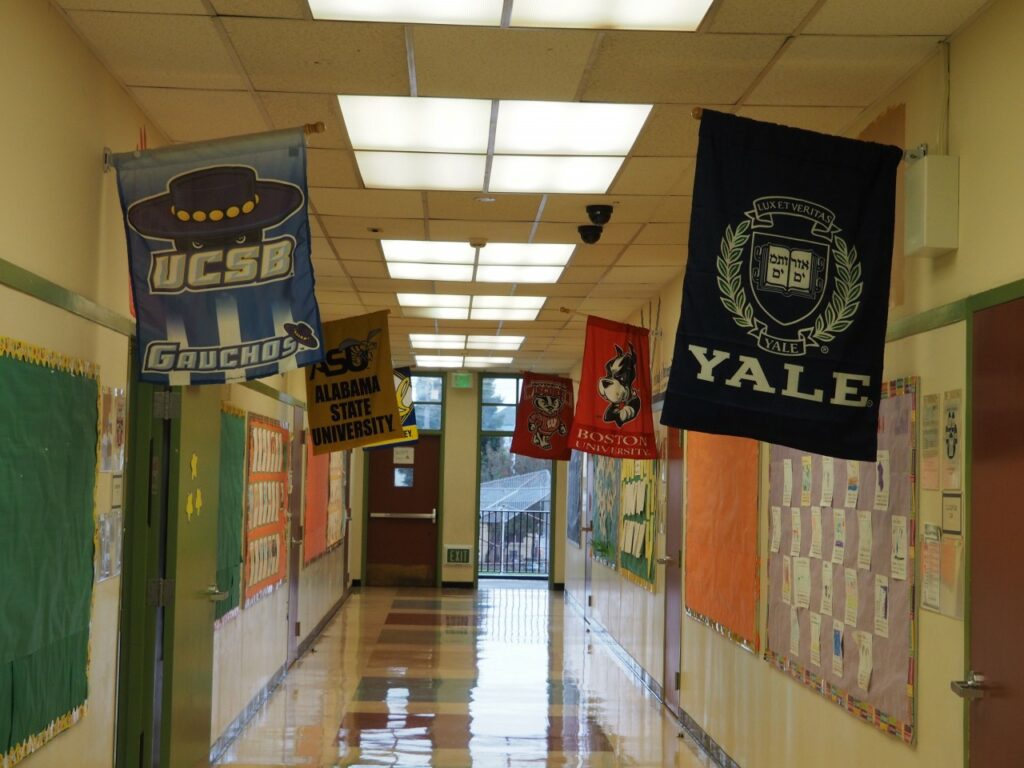 Liv Ames for EdSource
Programs that let students to earn high schoolhouse and higher credit at the same time are seen equally an effective manner to boost college success rates. However, numerous legislative efforts over the past decade to expand opportunities for students to have the courses accept withered.
Advocates argue that California should make it easier for students to admission the courses, which are growing in popularity across the nation as educational reforms increasingly focus on better preparing students to succeed later high schoolhouse.
"There'southward a broad consensus of evidence showing (dual enrollment's) effectiveness not just in providing a student a head start on college, but also in preparing them to exist successful in college and career afterwards on as well," said Christopher Cabaldon, executive managing director of the Linked Learning Alliance, a Sacramento-based nonprofit that advocates for career pathway programs that link academics with work experience.
"At that place'south been pretty broad consensus that it's valuable, simply the (California educational) lawmaking is all the same riddled with barrier later bulwark," Cabaldon said.
Dual enrollment, also known as concurrent enrollment, allows loftier schoolhouse students to enroll in community college courses and earn credits they can employ toward a college degree while also progressing toward a high school diploma. Research suggests that students who participate in the programs graduate from high school and enroll in college at higher rates, are less likely to require remedial courses and are more probable to earn higher degrees.
"Nosotros essentially treat dual enrollment in California almost like a felony," said Christopher Cabaldon, executive director of the Linked Learning Alliance.
California law limits the number of college units that high school students can earn through dual enrollment. State law also caps the number of students who can enroll in summer courses (although exemptions be for specific academic courses) and caps the number of students who can take physical pedagogy courses during the summertime. The limits were set after past abuses in which some college campuses claimed state funding for programs that amounted to picayune more than football game practice.
Lawmakers have tried numerous times to amend state police force, proposing bill subsequently bill to loosen the requirements to give campuses more than flexibility to offer the courses while including what they say are safeguards against misuse.
The current dual enrollment limit of 11 course units per term – about three classes – is too restrictive and tin hamper students' ability to access laboratory or other rigorous courses, which ofttimes count for a higher number of units than other courses, advocates debate. And high schoolhouse students are typically assigned a lower priority than other students when trying to enroll in community higher courses, which can go out them at a disadvantage when trying to access rigorous courses.
'Make it easier'
"We've got to arrive easier," said former Pasadena Assemblyman Anthony Portantino, who notes the success the programs have in boosting higher-going rates of low-income students, and those who are beginning in their families to attend college.
Portantino tried at least four times to significantly modify dual enrollment during his eight years in the Legislature, with the efforts stalling in Legislative appropriations committees.
"If you lot expect at our Grand-12 model, it was geared toward a different time of our economy," Portantino said. "To me, nosotros should move to a Thousand-14 model. For students who desire to articulate into a post-secondary degree, this will help them. And those students who are going to get into the workforce, they're going to need more than only a high school diploma."
At to the lowest degree nine bills to alter dual enrollment policies were proposed between 2004 and 2022 solitary, one assay said. Several of those efforts stalled in appropriations, the assay said, although the Legislature did corroborate measures that immune for exemptions to the cap on summer courses for students seeking higher-level transferrable courses, those attention vocational or career teaching programs, or those who needed additional help to pass the loftier school exit exam.
Just this year, at to the lowest degree 3 proposed bills would modify the state's dual enrollment policies, and a similar number were proposed final year.
One of the latest bills, Assembly Neb 288, is a follow-up to what many saw equally a promising, however failed attempt last year past Portantino'due south successor, Assemblyman Chris Holden, D-Pasadena, to offer campuses more flexibility in offering the courses. Holden'south pecker last year, AB 1451, died in the Senate Appropriations Commission.
AB 1451 would have raised the unit of measurement cap to 15 units, would have required Thou-12 districts and community colleges to forge partnerships to better coordinate academic and career pedagogy offerings and would have made it easier to offer college courses on high school campuses.
In their analyses of the various bills, legislative staffers have cited concerns over potential costs and program oversight.
The exact costs are impossible to calculate, considering it's unclear how many additional high school students will ultimately enroll in higher courses, said an analysis of AB 1451. Even so any growth could create "substantial ongoing" pressure to increase state funding for customs college enrollments, the analysis said.
The analysis also raised concern about what it says is lax oversight of caps already in place, specifically a police force that limits the number of high school students who can enroll in summer courses. No state agency enforced the caps or collected data to determine if the caps were exceeded, the analysis said – raising the issue that led to the current rules in the starting time identify.
Past abuse
Many of the current laws were enacted in the early on 2000s, after a serial of high-profile abuses of dual enrollment. In i Orange County case, some higher campuses were improperly claiming funding for students who were taking physical instruction courses or participating in football practice at their loftier school campus. Then-Gov. Arnold Schwarzenegger proposed withholding $80 one thousand thousand from the customs college upkeep in 2003-04 every bit penalisation, and the legislative limits were born.
The efforts to clamp downwards on abuse also came as California was entering the recession, forcing budget cuts that were limiting class options for regularly enrolled customs higher students.
The most recent legislative efforts aim to address many of those concerns, and include provisions that would guard against "double dipping" past preventing K-12 districts and community colleges from both receiving enrollment funding for the same educatee.
Holden'southward latest beak, AB 288, besides stipulates that any expansion of dual enrollment could not displace traditional community higher students.
The California Community Colleges Chancellor'southward Office supports AB 288, as information technology did last twelvemonth's AB 1451.

Assemblyman Chris Holden, D-Pasadena
Dual enrollment offers students early exposure to college and holds promise in decreasing the number of students who enter community colleges needing remedial work, community higher officials said. The majority of incoming customs college freshmen need extra assistance in math, English or both, and research shows that most of those volition drop out earlier completing a college degree.
"Whatsoever nosotros can practice to ensure that students come to the states ready to exercise higher-level work in math or English language is really of import," said Vincent Stewart, vice chancellor for governmental relations with the Community Colleges Chancellor's Role.
Still, any dual enrollment expansion could put boosted pressure on finite resources and raise the question of "mission creep" at community colleges, said Steve Boilard, executive director of the Center for California Studies at California State University, Sacramento.
"Community colleges are now moving into even granting 4-year degrees on one end," Boilard said, referring to a new law that sets upward a pilot program allowing some campuses to offer bachelor's degrees in vocational fields, "and are moving into a more Chiliad-12 area on the other end. It actually does suggest a very broad mission."
Loftier schoolhouse students tin can also admission dual enrollment courses through California's network of middle and early college high schools. The programs, most of which are located on community higher campuses, permit students to earn up to 60 transferrable higher credits while they complete loftier school. Many students will graduate with an acquaintance degree and a loftier school diploma.
Nearly 34,300 K-12 students in California were enrolled in credit-bearing community college courses in fall 2014, according to community higher data.
Leeway sought
Advocates argue it's time to bring more flexibility to California's dual enrollment policies, which are gaining popularity nationwide.
"We substantially treat dual enrollment in California almost like a felony," said the Linked Learning Alliance's Cabaldon. "We're 1 of the few states where, when nosotros think of dual enrollment, our primary interest is in guarding against corruption and not really the benefits of it."
In 2010-xi, 82 percent of high schools across the nation had students who participated in dual enrollment programs, with about half of that enrollment – or 601,500 students – in career technical pedagogy programs focusing on specific employment areas, according to a 2022 report from the Educational activity Commission of the States. That'south compared to virtually 400,000 students who participated in career education dual enrollment programs in 2002-03, the report said.
Gov. Jerry Brown has also signaled back up for better coordination between K-12 and community colleges, specially for efforts that promote college graduation and atomic number 82 to a ameliorate-prepared workforce.
Chocolate-brown has signed off on budget deals over the past two years that have included a combined $500 million for the California Career Pathways Trust, a grant program that promotes career education opportunities for students, peculiarly those that promise stronger partnerships between schools, colleges and businesses.
And the governor recently handed out $50 million in "innovation award" grants to colleges and universities for projects that streamline college completion, including programs that promote dual enrollment.
Holden hopes this year'south AB 288 could be the neb that brings some move to efforts to change dual enrollment limits.
The bill is more than narrowly focused than last year'due south AB 1451, in that it would let K-12 and community college districts to create formalized "College and Career Access Pathways" partnership agreements that would allow them to tailor dual enrollment to fit both student and campus needs.
The provision is modeled subsequently the 2022 Long Embankment College Hope Partnership Human activity, a constabulary that allowed the Long Beach Unified School District and the Long Embankment Community College District to forge agreements that expanded the use of dual enrollment. The number of Long Beach students completing college-level math and English has soared since the partnership was enacted, and the number of students who need remedial coursework upon inbound the city college has decreased, according to information from Holden's office.
The bill would also increment the course-unit of measurement cap to 15 units and would no longer put high school students on the lowest priority list when signing up for courses. The bill also requires that districts provide a detailed, almanac report on their dual enrollment to the country Legislature, the Department of Finance and the state superintendent of public educational activity; current limits on summertime enrollment and physical education requirements would not be contradistinct, Stewart said.
AB 288 would also make it easier to offer college courses on loftier schoolhouse campuses – a provision of past bills that has raised business from K-12 and customs higher faculty groups who question how the courses will be structured, and who will teach them. The nib stipulates that no high school or college kinesthesia could be displaced if dual enrollment opportunities are expanded.
Neither the community college kinesthesia association nor the California Teachers Association, which represents K-12 teachers, accept taken a position on AB 288, and Holden has already introduced amendments to the beak to assuage some faculty concerns.
Holden is hopeful the nib will pass this yr, even so understands the legislative procedure that has stalled past efforts.
"Nosotros're trying to find the correct balance, and it's very delicate," Holden said.
"We do believe the benefits of the bill are really solid," he said, "and the benefit to the students is very clear. If we could get the mensurate on the governor's desk, I remember the governor would be willing to support it."
To become more reports like this one, click here to sign up for EdSource'southward no-cost daily email on latest developments in didactics.
Source: https://edsource.org/2015/lawmakers-try-and-try-again-to-expand-dual-enrollment/77487
0 Response to "Lawmakers try and try again to expand dual enrollment"
Post a Comment